
Your plating line runs on DC. The rectifier is what turns plant AC into that DC. While the fundamental principle—connecting positive to anode and negative to cathode—remains constant, an industrial electroplating rectifier demands specific attention to control methods, modular architecture, and safety protocols that differ substantially from benchtop units.
Understanding Your Rectifier’s Control Type
Industrial plating rectifiers generally fall into two control categories, and your operating procedure depends on which type you have.
SCR (Thyristor) Controlled Rectifiers
These units regulate output by controlling the firing angle of thyristors. Older tap-switch models require careful balancing of three separate tap selectors—the position difference between any two switches must not exceed one step, or transformer overheating may result. Newer models replaced the tap selectors with a panel potentiometer or digital controller.
High-Frequency Switching Rectifiers (IGBT/MOSFET)
This is the predominant technology in contemporary industrial installations, including Liyuan Haina’s product line. These units run low-voltage MOSFET or IGBT modules at high frequency, which is where the 0.95+ power factor and 90%+ efficiency numbers come from. Liyuan Haina builds RS485, 4-20mA, and 0-10V signal support into these units as standard.
Wiring the Output to Your Plating Tank
Connect the positive terminal to the anode bus bar. In Liyuan Haina systems, anode connections often use red-coded wires or copper bus bars. Connect the negative terminal to the cathode bar holding your workpiece. The negative side is typically black-coded.
For rectifiers equipped with RS485 digital control, you will also route a communication cable to your PLC or host computer.
The positive and negative bus bars must never touch. At a few thousand amps, a short circuit turns metal into vapor and molten spray. People have been burned badly this way.
Calculating and Setting Current
The plating rate depends on current density, not voltage. Voltage is merely the electromotive force that drives current through the electrolyte.
For copper plating, a common industrial benchmark is 18 amperes per square foot of surface area to deposit 0.001 inches (25 microns) in one hour. Nickel requires approximately 1 ampere per 15 to 16 square inches. Hard chrome pulls far more current—hundreds of amperes per square foot, not tens.
Set your rectifier to constant current (CC) mode once you know the amperage your part requires. Liyuan Haina units offer selectable constant voltage/constant current operation, with current regulation accuracy of ≤1%.
Industrial Features Specific to Liyuan Haina Rectifiers
Liyuan Haina’s plating power supplies incorporate several design elements that affect daily operation.
Modular Parallel Architecture
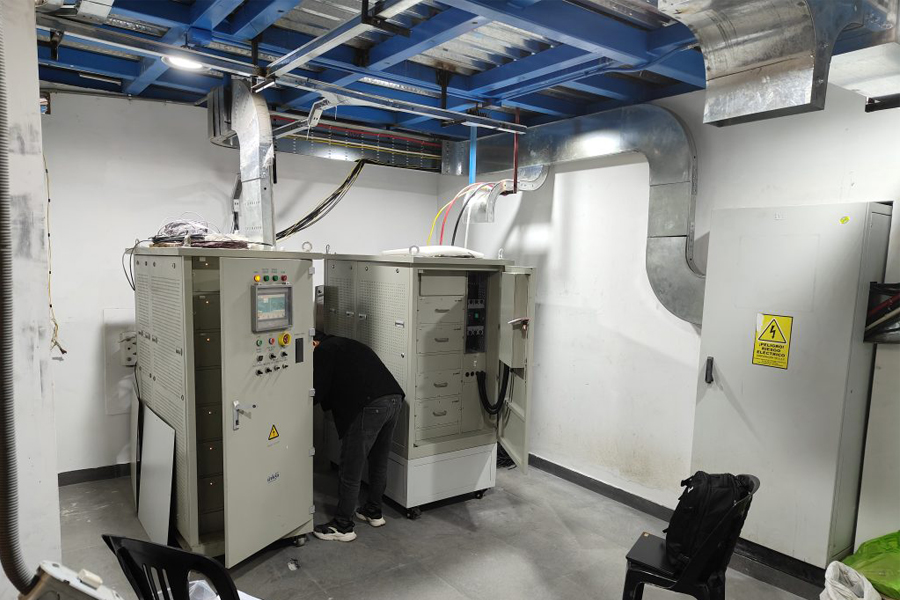
High-current models are constructed from multiple identical modules operating in parallel. A single unit may contain several modules sharing the load, with automatic current balancing maintained within 1% between modules. You set the total current at the system level; individual modules adjust automatically.
N+X Redundancy and Hot-Swap Maintenance
Larger Liyuan Haina rectifiers support N+X redundant configurations, meaning spare modules can be installed alongside active ones. If a module fails, replacement is possible without shutting down the rectifier. Simply set the new module’s address code to match the failed unit’s address and insert it—the system recognizes and integrates the replacement automatically.
No Internal Water Joints
For water-cooled models, Liyuan Haina specifies that individual unit enclosures contain no internal water pipe joints. This design choice minimizes leakage risk in the corrosive plating environment.
Conformal Coating Protection
Circuit boards receive a three-proof conformal coating resistant to acid mist and moisture, extending component life in the harsh tank-side atmosphere.
Operational Sequence
- Verify wiring with the rectifier powered off and the AC disconnect open.
- Check module addresses if your unit uses modular parallel configuration—mismatched addresses cause unequal load sharing.
- Set control mode to constant current (CC) on the front panel or through your PLC.
- Turn on the AC supply, then enable output. Liyuan Haina rectifiers include soft-start functionality, which ramps output gradually rather than applying full current instantly.
- Adjust current to your calculated setpoint. The digital display typically shows amperage resolution of 1A and voltage to 0.01V on higher-current models.
- Monitor during plating. Watch for current drift, which may indicate anode passivation, poor contact at bus bar connections, or electrolyte depletion.
- Shutdown sequence: reduce current setpoint to zero, disable output, then open the AC disconnect.
Safety Considerations for Industrial Installations
The primary hazard is not voltage but current. Plating voltages are typically 4-6V—comparable to a flashlight battery—but an electroplating rectifier can deliver thousands of amperes. This combination makes the plating circuit extremely dangerous if shorted.
No metal tools near energized bus bars. A dropped wrench across the anode and cathode bars will vaporize metal, spray molten droplets, and potentially cause arc flash.
Nitrile or rubber gloves are not optional here. They protect against both chemical splashes and accidental contact with energized conductors.
Ventilation matters more than most people think. Plating solutions release acid mists and other vapors that corrode electronic components over time—a failure mode not covered under most warranties.
Bus bars and cable terminations get hot, especially at poor connection points. A routine infrared scan during maintenance catches loose connections before they fail.
Among them, our electroplating rectifiers are extensively utilized for PCB electroplating, hard chrome coating, copper/nickel/zinc plating, and precious metal plating with gold and silver — delivering reliable power solutions for diverse hardware surface treatment applications.