

Choosing between SCR and IGBT electroplating rectifiers starts with understanding how each technology affects your production quality, energy costs, and maintenance schedule.
How DC Quality Affects Your Parts
All rectifiers convert AC to DC and try to keep that DC steady as load changes. When parts enter or exit the bath, the electrical load shifts. Some rectifiers take time to catch up. During that lag, current density drifts. Thickness readings taken from the first rack of a shift often do not match those from later racks when the rectifier responds too slowly. A faster-reacting rectifier corrects output before the deviation leaves a mark on the parts.
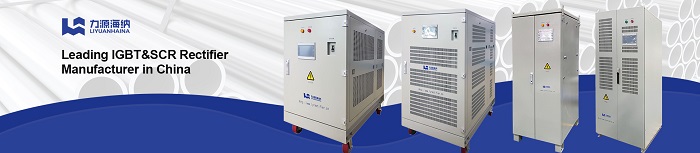
SCR vs IGBT: Performance Comparison
| Parameter | SCR Rectifier | IGBT Rectifier |
|---|---|---|
| Transformer | Power frequency — very large and heavy | High frequency — compact, fraction of the weight |
| Control mode | Phase-shift trigger | PWM modulation |
| Control speed | Slow (10 ms response) | Fast (< 0.1 ms response) |
| Regulation accuracy | < 5% | < 1% (as low as 1‰ available) |
| Ripple coefficient | < 10% | < 0.5–3% |
| Efficiency | < 85% | ≥ 93% |
| Power factor | 0–0.85 (varies with load) | ≥ 0.95 |
| Grid interference | High — difficult to filter | Very low — easy to eliminate |
| Maintenance | Troublesome — entire unit shuts down | Modular — hot-swap without system shutdown |
Type Selection by Application
SCR rectifiers remain common in heavy industry. With fewer electronic parts that can fail, they appeal to operations that value dependability over precision. When part geometries are simple and plating tolerances allow variation, SCR delivers acceptable results at a lower upfront cost. For operations requiring tighter process control and higher efficiency, explore custom electroplating power supply solutions designed for your specific production requirements.
IGBT switch-mode rectifiers dominate new production lines. They hold setpoints tightly, produce DC with very low ripple, and take up less floor space — whether for new builds or retrofits.
Pulse-plating power supplies cycle output on and off at set intervals, influencing metal grain structure. Semiconductor and precious-metal plating benefit from improved deposit density and reduced material waste.
Industry Requirements
Aerospace and automotive lines need consistent output across full shifts, minimal waste heat, and uniform coating thickness from first rack to last.
PCB manufacturers prioritize output purity. Ripple causes uneven copper build-up on hole walls — a defect that escapes electrical testing and surfaces later as field failures. Industry guidelines such as IPC standards address acceptable ripple limits for reliable through-hole plating.
High-volume hardware producers (fasteners, brackets, structural parts) evaluate rectifiers on energy consumption and service accessibility, as both hit narrow margins directly.
Decorative and precious-metal platers work with expensive chemistry and visible surfaces. Even minor current fluctuations produce color shift, haze, or uneven brightness.
Cooling Method
Air-cooled units cost less upfront. Give them clearance and clean filters periodically. Suitable for single-shift operations or cooler workshops.
Water-cooled units draw heat out faster and maintain stable semiconductor temperatures under full load. Requires water supply and loop maintenance. Better for 24/7 operations or warmer climates.
The right choice depends on operating hours, plant layout, and available utilities.
Reliability and Serviceability
Monolithic designs concentrate all power electronics in one assembly. Failure means the entire line stops. Diagnosis takes trained technicians. Parts sourcing can take days.
Modular parallel designs split load across independent sections. If one module fails, others keep working — line stays up at reduced capacity. A bad module swaps out in about an hour. In-house electricians can handle it.
Modularity does not prevent failures. It changes the consequence from “line down for days” to “reduced throughput for an hour.”
Future-Proofing Your Specification
Plating requirements evolve — new chemistries, tighter standards, automation. Rectifiers with digital communication ports (RS485, Modbus, Profibus) and programmable profiles allow integration with line control systems and faster changeovers. Adding these features at purchase costs little compared to replacing equipment later.
Frequently Asked Questions
Q: Should I replace my aging SCR before it fails?
Compare current power consumption against published efficiency data for modern IGBT units. For 24/7 operations, energy savings often recover much of the replacement cost within two to three years. Replacing on your schedule also avoids an unplanned failure at the worst possible moment.
Q: How can I tell if ripple is causing quality issues?
Run a Hull cell test panel with your current unit, then repeat with a low-ripple rectifier. If the second panel shows more consistent plating across the current-density range, ripple is likely contributing to your problem.
Q: What routine maintenance does an IGBT rectifier need?
Monitor the cooling loop — check water quality on liquid-cooled units, clean air filters on air-cooled units. Calibrate sensors periodically. Under normal service, primary power stages typically outlast the equipment’s operational life.
Q: What shortens rectifier life most?
Temperature. Internal semiconductors wear out faster when hot. Good cooling and conservative derating for continuous service are the two most effective ways to maximize service life.
Q: Are custom output configurations available?
Some suppliers engineer non-standard specifications. Provide bath chemistry, anode-cathode geometry, and output waveform requirements for a feasibility assessment and cost estimate.
Consult your equipment supplier’s product documentation for complete technical specifications and installation guidelines.
Among them, our electroplating rectifiers are extensively utilized for PCB electroplating, hard chrome coating, copper/nickel/zinc plating, and precious metal plating with gold and silver — delivering reliable power solutions for diverse hardware surface treatment applications.